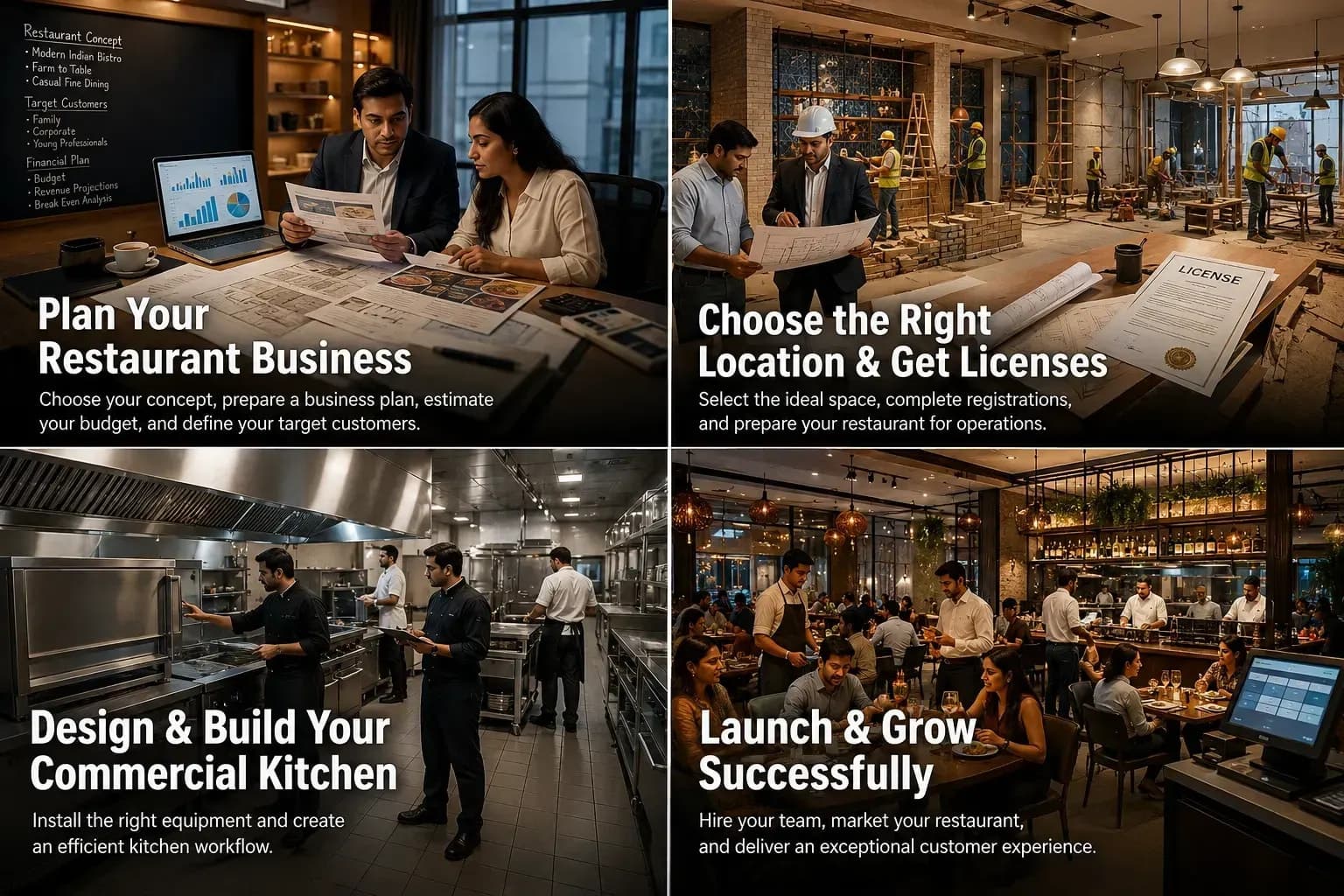
How to Start a Restaurant in India: A Step-by-Step Guide
Starting a restaurant in India is one of the most rewarding — and demanding — businesses you can build. The opportunity is real: food services is among India's largest and fastest-growing sectors, powered by rising eating-out habits and an explosive food-delivery market. But success depends far less on a passion for food than on getting the fundamentals right — the concept, the numbers, the licenses and the kitchen. This guide walks you through all ten steps in the exact order an experienced operator would take them.
Why Trust This Guide
This guide is written by the team at VSD International. For over 15 years we've designed, manufactured and installed commercial kitchens for restaurants, hotels, QSR chains and institutions across India. While we don't run restaurants ourselves, we've worked alongside hundreds of owners at the exact moment they set one up — so the practical insights here, especially on kitchens, compliance-readiness and the mistakes that cost first-timers money, come from direct experience. For legal and financial specifics, we link to official government sources so you're always working from the authoritative reference.
The 10 Steps to Open a Restaurant in India (Overview)
| # | Step | What it involves |
|---|---|---|
| 1 | Concept & format | Choose your restaurant type, cuisine and target customer |
| 2 | Business plan | Document the model, market, menu and finances |
| 3 | Budget & funding | Estimate costs and arrange capital |
| 4 | Location | Find and lease the right space |
| 5 | Registration & licenses | Register the business; get FSSAI, GST and local licenses |
| 6 | Kitchen setup | Design the layout and install equipment |
| 7 | Suppliers & inventory | Source ingredients, packaging and vendors |
| 8 | Staffing | Hire and train kitchen and service teams |
| 9 | Technology | Set up POS, billing and delivery platforms |
| 10 | Marketing & launch | Build buzz and open the doors |
Step 1 — Decide Your Restaurant Concept and Format
Everything else flows from this decision. Your format determines your capital, space, licenses and staffing — so settle it first.
Popular Restaurant Formats in India
| Format | What it is | Relative capital | Typical break-even feel |
|---|---|---|---|
| Fine dining | Full-service, premium | High | Slower |
| Casual dining | Full-service, mid-market | Medium–High | Moderate |
| QSR / fast food | Quick service, counter-based | Medium | Faster |
| Café / coffee shop | Beverages and light food | Medium | Moderate |
| Cloud kitchen | Delivery-only, no dine-in | Low | Fastest |
| Food truck / kiosk | Mobile or compact | Low | Fast |
If capital or risk is a concern, many first-time owners now begin with a cloud kitchen — a delivery-only model that skips the cost of a dining area and front-of-house staff. It's the leanest way to test a concept before committing to a full restaurant. (See our guide on how to start a cloud kitchen in India.)
Choosing Your Cuisine and Target Customer
Pick a cuisine you can execute consistently and that suits your area's audience. Be specific about who you're serving — students, families, office crowds, late-night delivery — because that single choice shapes your menu, pricing, portion sizes and even your equipment. A North Indian and Chinese multi-cuisine menu, for instance, needs a tandoor and a Chinese range that a café simply won't.
From experience: the owners who succeed decide their menu before their equipment — never the other way round. Your menu dictates your kitchen, not the reverse.
Step 2 — Write a Restaurant Business Plan
A business plan forces you to test the numbers before they become real. It needn't be long, but it should cover:
- Concept and menu — what you serve and why it will sell
- Market and competition — who else is nearby and how you'll differ
- Location strategy — the area and footfall you need
- Financial plan — setup cost, running cost, projected revenue and break-even
- Operations — kitchen, staffing and supply plan
- Marketing plan — how customers will find you
If you're seeking investors or a bank loan, this is the first document they'll ask for.
Step 3 — Estimate Your Budget and Arrange Funding
What It Costs to Open a Restaurant in India
Costs vary enormously by city, size and format, so treat the figures below as indicative planning ranges, not quotes.
| Cost component | Indicative range |
|---|---|
| Security deposit + rent (3–6 months) | ₹3 – 15 lakh |
| Interiors, furniture & fit-out | ₹5 – 25 lakh |
| Commercial kitchen equipment & setup | ₹8 – 40 lakh |
| Licenses & registrations | ₹50,000 – 3 lakh |
| Initial inventory | ₹1 – 5 lakh |
| Staff (first 2–3 months) | ₹2 – 8 lakh |
| Branding, POS & marketing | ₹1 – 5 lakh |
| Working-capital buffer | ₹3 – 10 lakh |
| Total (indicative) | ₹25 lakh – ₹1 crore+ |
A worked example. To make this concrete, here's how two very different formats compare at the planning stage:
| 30-seat casual dining (metro) | Single-brand cloud kitchen | |
|---|---|---|
| Rent & deposit | ₹6–12 lakh | ₹1–3 lakh |
| Interiors | ₹12–20 lakh | Minimal |
| Kitchen equipment | ₹15–30 lakh | ₹5–10 lakh |
| Licenses | ₹1–3 lakh | ₹50k–1.5 lakh |
| Indicative total | ₹40–80 lakh | ₹8–18 lakh |
The kitchen is usually one of the largest and most important line items — under-investing here is a common and costly mistake, because equipment failures during service directly hit revenue. We break the kitchen budget down fully in our guide to the cost of opening a restaurant in India.
How to Fund Your Restaurant
Common routes include personal savings, a partnership to pool capital, a bank or MSME business loan (register on Udyam for MSME benefits), or outside investors for larger concepts. Keep a working-capital buffer for at least the first three months — most restaurants take time to reach steady footfall, and running out of cash before then is a leading cause of early closure.
Step 4 — Choose the Right Location
Location can make or break a restaurant. Evaluate each option against:
- Footfall and visibility — the right kind of traffic for your format
- Rent-to-revenue — a common guideline is to keep rent within roughly 8–15% of projected sales; higher, and the model gets fragile
- Competition and complementary businesses nearby
- Kitchen feasibility — enough space, power, water, gas, and room for proper exhaust and ventilation
- Delivery reach — order density in the delivery radius, if you'll be on Swiggy and Zomato
- Parking and accessibility for dine-in formats
For delivery-led formats, order density matters far more than street footfall — which is exactly why cloud kitchens can succeed in cheaper, low-visibility locations.
Step 5 — Register Your Business and Get Your Licenses
Business Registration and GST
First, choose a structure — a sole proprietorship is simplest for a single small outlet, while an LLP or Private Limited company suits partnerships and investor-backed ventures. Then register for GST, required once you cross the turnover threshold and useful for claiming input credit on your setup costs.
Licenses Every Indian Restaurant Needs
Operating without the correct licenses risks fines and closure, so build time for these into your plan.
| License / Registration | Issued by |
|---|---|
| FSSAI Food License | Food Safety and Standards Authority of India — mandatory for every food business |
| GST Registration | GST portal |
| Shops & Establishments Registration | State labour department |
| Health / Trade License | Local municipal corporation |
| Fire Safety NOC | State fire department (especially larger premises) |
| Eating House License | Local police (required in many cities) |
| Liquor License | State excise department (only if serving alcohol) |
| Signage License | Municipal corporation |
The FSSAI license is non-negotiable and the one to start early — we cover it fully in our FSSAI license guide. For the complete, city-wise breakdown, see our guide to the licenses and permits needed to open a restaurant in India.
From experience: the two steps that most often delay an opening are licensing and kitchen installation. Start both early and run them in parallel with your interiors, rather than in sequence.
Step 6 — Design and Set Up Your Commercial Kitchen
The kitchen is the engine of your restaurant. A well-designed one keeps service fast, safe and consistent; a poorly designed one slows every shift and fails hygiene audits.
Layout and Workflow Come First
Before buying a single machine, plan the layout. A good commercial kitchen gives food a clean, one-directional flow — receiving, storage, preparation, cooking, plating and warewashing — so staff and ingredients never cross paths. The right configuration depends on your space and menu, from a tight galley line for a compact QSR to zoned stations for a multi-cuisine restaurant. Our guide to restaurant kitchen layout ideas covers the common floor plans.
The Equipment Your Kitchen Needs
Your equipment list follows your menu. A typical restaurant kitchen includes:
- Cooking line: ranges, fryers, griddles, salamanders, ovens, and a tandoor or Chinese range for Indian and multi-cuisine menus
- Preparation & cold stations: work tables, food processors, cold counters
- Refrigeration: under-counter and vertical units, and a walk-in for larger kitchens
- Warewashing: dishwashers, sinks, pre-rinse and grease traps
- Exhaust & ventilation: hoods and ducting sized to your cooking load and fire code
- Custom stainless-steel fabrication: tables, hoods, sinks and shelving built to your layout
Our restaurant kitchen equipment checklist lists everything by station. Because the kitchen is technical, compliance-sensitive and expensive to get wrong, most owners work with a specialist who can design, supply and install the whole kitchen under one contract rather than piecing it together from separate vendors — protecting the timeline, the budget and the ability to pass FSSAI and fire inspections. VSD International provides exactly this as a turnkey restaurant kitchen setup service, from CAD layout to installation.
Step 7 — Line Up Your Suppliers and Inventory
Reliable suppliers keep your kitchen running. Source and negotiate with vendors for fresh produce, staples, meat and dairy, packaging (critical for delivery) and cleaning supplies — ideally with a primary and a backup for each essential. Set up simple inventory tracking from day one to control food cost, your biggest variable expense. A common target is to keep food cost around 25–35% of sales, though it varies by cuisine.
Step 8 — Hire and Train Your Team
Your team delivers the experience. Core roles usually include:
- Kitchen: head chef, line cooks, kitchen helpers, dishwashers
- Service (dine-in): captains, servers, cashiers
- Management: a restaurant manager to run daily operations
Hire for attitude and train for skill, document your recipes and mise en place for consistency, and make food-safety and hygiene practices part of onboarding — it protects both your customers and your FSSAI compliance. Watch your prime cost (food cost + labour cost combined); keeping it under roughly 60–65% of sales is a widely used benchmark for a healthy restaurant.
Step 9 — Set Up Billing, POS and Delivery Platforms
A POS (point-of-sale) system handles billing, tracks sales and manages inventory — choose one that fits your format and integrates with delivery. Then register on the platforms your customers use: Swiggy and Zomato, and increasingly ONDC, which is reshaping delivery economics by reducing aggregator dependence. For delivery-led formats especially, getting onboarded and well-reviewed on these platforms is as important as the storefront itself.
Step 10 — Plan Your Marketing and Launch
Build anticipation before you open and momentum after:
- Pre-launch: set up your Google Business Profile and social handles, seed local awareness, and consider a soft launch or tasting for friends, family and local influencers.
- Launch: an opening offer, strong food photography, and active, well-optimised listings on delivery apps.
- Ongoing: collect and respond to reviews, run seasonal offers, and keep your Google Business Profile active — for a restaurant, local search visibility drives walk-ins.
How Long Does It Take to Open a Restaurant in India?
Most restaurants take three to six months from decision to opening. Licensing and kitchen setup are the two steps that usually determine the timeline, so start the FSSAI application and kitchen design early and run them in parallel with interiors. A compact cloud kitchen can open faster — sometimes in a few weeks — because the setup is far leaner.
Common Mistakes First-Time Restaurant Owners Make
Learning from others' errors is cheaper than making your own:
- Under-budgeting the kitchen and buying equipment that can't handle service volume
- Ignoring licenses until late, then delaying the opening
- Choosing a location on rent alone, without checking footfall or delivery density
- No working-capital buffer, leaving no runway for the slow first months
- A menu that's too large to execute consistently or stock efficiently
- Skipping proper kitchen ventilation, causing heat, hygiene and fire-compliance problems
Your Restaurant Launch Checklist
- Concept, format and menu finalised
- Business plan written
- Budget set and funding arranged
- Location leased
- Business registered; GST done
- FSSAI and all local licenses applied for
- Kitchen designed, equipment installed and tested
- Suppliers and inventory system in place
- Team hired and trained
- POS, billing and delivery platforms live
- Google Business Profile and social handles set up
- Launch plan ready